Electronic Systems Technology
Overview

The Electronic Systems Technology lab at TCHS is a comprehensive program of study encompassing the many aspects of electronics technology. Drawing on real-world experiences of the instructor, EST teaches students basic circuit design and analysis.
Qualified students may earn college credits through our Applied Engineering Technology courses.
Third-year students may have the opportunity to participate in the cooperative education program, where they will receive on-the-job training and experience in the electronics industry.
Two and Three Year Programs in EST
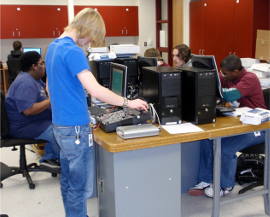
The Electronic Systems Technology (EST) program at TCHS offers students the opportunity to learn electronics design and troubleshooting skills. These skills are essential for young men and women who want to enter technology-related fields straight out of high school or enter the military with technology skills.
In the EST program students learn the basics of electronics, including how batteries work, what voltage is, how current is controlled, how to work safely with low-voltage circuits, where to find important information about components, and how to solder.
Students who enter the EST program learn electronics in three important ways:
- Theory: We learn electronics through lecture and assessment.
- Labs: We learn electronics by working with our hands and our minds.
- Computer-Assisted Training: What we heave learned is reinforced through our Lab-Volt training system. It introduces theory and then directs us to explore circuits through interactive training.
Earn College Credits Through AET
Applied Engineering Technology (AET) at TCHS offers students the chance to earn college credits through DCCC. The courses that are offered through the AET program are:
- DC Analysis - the basic principles of direct current circuits.
- Electronics I - semiconductor theory, Diode theory, Zener diodes, special use diodes and LEDs.
- Electronics II - differential amplifiers, OP-AMP circuits, components and timers.
- Digital Electronics - digital logic gates and integrated circuit.
Each of these courses is a four credit college course, giving qualified students the opportunity to earn up to a total of 16 college credits while the are TCHS students.
To qualify for the AET program, a student must maintain a GPA of at least 3.0 at their sending schools and receiving a qualifying score on the Career Scope test.
Students must pass an exam administered by a DCCC Electronics Technology instructor for each of the courses for which they wish to receive credit.


